mercoledì 17 febbraio 2021

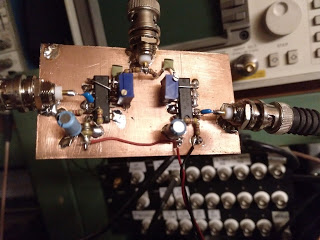
Double Symmetrically Comb Generators added together

 Following the post : 

How to easily improve by a factor of 100 the measurement of the frequency difference between two reference oscillators

https://air-radiorama.blogspot.com/2021/02/how-to-improve-by-factor-of-100.html

This is the drawing of the two symmetrically Comb Generators added together :


martedì 16 febbraio 2021

Francobollo 90anni della Radio Vaticana


Dalle Poste vaticane un francobollo per il 90°
della Radio del Papa


Un doppio anniversario fissato in un foglietto filatelico: si festeggiano i 90 anni dalla fondazione della Radio vaticana e i 160 dalla nascita de L'Osservatore Romano. L'omaggio, nel blocco in uscita il 22 febbraio 2021 insieme ad una ricca emissione filatelica.

Tratto da

https://www.vaticannews.va/it/vaticano/news/2021-02/dicastero-radio-vaticana-osservatore-anniversario-poste.html


via Bruno Pecolatto-AIR130


AIRE NAZIONALE E AIRE TOSCANA – INTERVENTI DELLA 10MA GIORNATA MONDIALE DELLA RADIO 2021 – UNESCO


 https://www.umbertoalunni.it/aire-nazionale-e-aire-toscana-interventi-della-10ma-giornata-mondiale-della-radio-2021-unesco/


giovedì 11 febbraio 2021

WORLD RADIO DAY 2021

COS'È IL WORLD RADIO DAY?

Il World Radio Day è la Giornata Mondiale della Radio proclamata dall'UNESCO per il 13 Febbraio di ogni anno.

Anche l'Italia celebra la Giornata Mondiale della Radio con i più grandi protagonisti delle Radio Nazionali, Locali, Web e Universitarie.

https://www.worldradioday.it/


via Bruno Pecolatto-AIR 130

WORLD RADIO DAY - X° Giornata Mondiale della Radio - MUMEC


A tutti gli amici del MUMEC Museo dei Mezzi di Comunicazione di Arezzo

Inviamo con la presente, l’invito per la partecipazione al convegno di celebrazione del


WORLD RADIO DAY - X° Giornata Mondiale della Radio
Venerdì 12 febbraio 2021 alle ore 16:00 


L'evento, indetto da UNESCO, sarà celebrato dal Museo con convegno online assieme ai partner principali: Centri per l’UNESCO di Arezzo e Firenze, RAI TOSCANA ed AIRE Associazione Italiana per la Radio d’Epoca. Maggiori info in locandina allegata alla presente


Per partecipare collegarsi al link zoom alle venerdì 12 febbraio alle 15:45:


Entra nella riunione in Zoom
https://zoom.us/j/97305237877

ID riunione: 973 0523 7877
Passcode: 072093


via Bruno Pecolatto-AIR130

martedì 9 febbraio 2021

How to easily improve by a factor of 100 the measurement of the frequency difference between two reference oscillators

Recently I had the idea to improve the possibility to quick measure the frequency difference of two reference oscillators , in this case two Rubidium Oscillators : a Rhode Schwarz and an M100 that I put into a yellow rack with a power supply , as in the pictures .

The method is based on :

A) Multiplying by 100 the frequency of both oscillators ( with the use of  simple home made Comb Generators )

B) Comparing the  frequency of the two oscillators with the method of the " beats " at 1 GHz , using a selective receiver . In the test I have used a Spectrum Analyzer , but every simple receiver , even an RTL Dongle can be used with the same results .

The two Comb Generator needed was made with two EX-OR fast ports ( ACT86) , with one of the two inputs connected directly and the second through  a variable resistor that , with the input capacitor of the port ,add a small delay .

The drawings can be found here : http://air-radiorama.blogspot.com/2021/02/double-symmetrically-comb-generators.html


The input is so a very sharp pulse depending on the rise and fall time of the EX-OR and of the delay of the RC constant ( in the range of ns ) .

Trimming the resistor the component at 1 GHz was at a comfortably level of -50 dBm .

The output of the two Comb generator was summed simply with two capacitor and two resistors .

You can find here the images of the output of a single Comb Generator , wide band and relatively narrow band .


What can we espect from this setup while summing the signal of the two Comb Generator at 1 GHz coming from the two Rubidium ? 

The composition of the two signals will change from a maximum of +3 dB when the phase of the two oscillator is the same and to a minimum ( if the signals are exactly equal of ) zero .

In this case the spread is around 20 dB , but doesn't matter because we have only to count the cycles .

The maximums will be always very wide , while the nulls will be always very sharp .

To check this I have tuned the Rubidium M100 as far as was possible , and you can see in the first part of the following screen with zero span ( this means that the Spectrum Analyzer acts as a receiver tuned at 1 GHz with vertical logaritmic scale ) .

Please note that the horizontal time sweep is 1000 s ( 100 second/div) .

At the beginning you can count around 10 oscillations in 100s , that means one cicle each 10 seconsd = 0,1 Hz of difference at 1 GHz .

Being 1 GHz = 10E9 Hz , this means a frequency maximun difference of 10E-10 .

While time was running , I have changed the frequency of the Rubidium M100 to approach that one of the RS Rubidium .

At the end of the screen the difference is around one cycle each ten second at 1 GHz , that means 10E-11.


Continuing the approach of the frequencies , I have increased the timebase till 6000 s because the phase change was very slow .


At the end , using sequential methof of approximation , in the last picture ,it is not easy if impossible to see a real periodicity in the phase rotation and so in the frequency difference .

We are in the range of 10E-12 . I am pretty sure that this limit doesn't depend from the method of measurement ( being a "physical method ") , but from the limit of stability ( jitter ) of one ( if not both ) Rubidium Oscillator , and this was the scope of the experiment .

If I am right , this simple setup , that everyone can easily reproduce at low cost , can measure stability higher than that of Rubidium Oscillators .

To check this with no dubts , I need two oscillator with performance 10 times better than the rubidium oscilllator I have used .

Hope one day I can check this , if I am so crazy to invest in two Masers  , because actually I am only playing to infringe my limits .....

But I have another couple of Rubidium Oscillators from  Stanford that I can try to check in the same way ....


Seminar with small video from Minicircuits

domenica 7 febbraio 2021

Discovery Science on Judica Cordiglia Brothers

Recorded some time ago with my cellular phone from the TV set . The audio is low , but understandable .

martedì 12 gennaio 2021

Marconi Club QSO Party Day 2021


Ciao Bruno

ti comunico che il Marconi Club ARI Loano organizza la terza edizione del "MARCONI CLUB QSO PARTY DAY 2021 " sabato 16 Gennaio 2021 dalle 08.00 utc alle 22:00 utc. Una giornata on-air per far conoscere alle nuove generazioni il nostro club e riunire in radio tutti coloro che veramente amano e credono nella stupenda arte della telegrafia.
Durante la manifestazione, verranno coinvolti tutti gli iscritti allo storico club , che conta ad oggi oltre 850 iscritti da ogni parte del globo e tutti gli appassionati di questa magnifica arte.
Ti alleghiamo il regolamento, la locandina dell'evento, ti chiediamo cortesemente di dare massima diffusione sul sito web di AIR-RADIORAMA
ti ringrazio e ti saluto un abbraccio 73' 
 
Walter IK1QAD
Award Manager
MARCONI CLUB ARI LOANO

MARCONI CLUB ARI LOANO QSO PARTY DAY edizione 2021 La sezione A.R.I di Loano ripropone per il 2021 la 3° edizione del Qso Party Day, con la finalità di far conoscere alle nuove generazioni il nostro club e riunire tutti coloro che veramente amano e credono nella stupenda arte della telegrafia. Lo scopo della manifestazione è quello di promuovere il MARCONI CLUB A.R.I. LOANO, fondato l'8 maggio 1988 dal compianto Libero Meriggi I1YXN e dal noto DXpeditioners Baldur Drobnica DJ6SI. Per la buona riuscita della manifestazione, si chiede a tutti gli appartenenti al Marconi Club ed ai semplici appassionati non iscritti, di dedicare qualche ora al tasto….. Data: 16/01/2021 Ora: dalle 08:00 UTC – 22:00 UTC Banda: 20m - 40m - 80m Rapporti: Tutte le stazioni chiameranno “CQ MCD” Gli iscritti al MARCONI CLUB A.R.I. Loano passeranno il rapporto RST seguito dal numero di appartenenza al club. I non iscritti, dovranno collegare solo stazioni iscritte al Marconi Club A.R.I. Loano e passeranno il rapporto RST + n. progressivo. LOG Il log elettronico in formato .doc , .xls o .txt dovrà essere inviato solo via email entro il 25-01-2021 a marconiclub@ariloano.it I LOG dovranno essere compilati comprendendo obbligatoriamente i seguenti dati: Data, Ora UTC, Call, Banda, Modo, numero Marconista e i dati del partecipante compreso indirizzo e-mail. Attestato: a tutti i partecipanti, sarà inviato solo via e-mail un attestato di partecipazione in formato elettronico PDF. DIPLOMA PERMANENTE: I collegamenti con le stazioni appartenenti al MARCONI CLUB ARI di Loano sono validi per il conseguimento del diploma permanente “Marconista". Il regolamento e l’elenco dei soci aggiornato , è riportato sul sito web www.ariloano.it/marconiclub Esempio collegamento : Chi chiama: CQ CQ MCD de IK1QBT AR K chi risponde: IK1QBT de IU1XXX K Chi chiama: IU1XXX de IK1QBT 599 Marconi Club nr. 260 K chi risponde: IK1QBT de IU1XXX 599 nr.001 K Vi aspettiamo numerosi. 73’ de IK1QAD Walter Award Manager Marconi Club A.R.I. Loano

via Bruno Pecolatto-AIR130