Visualizzazione post con etichetta Signal Predator. Mostra tutti i post

domenica 2 febbraio 2020

Elenos Signal Predator measurement with several IF frequencies of receivers


The main features of Elenos Signal Predator are : 

- Direct Sampling SDR - 16 bit precision

- Continuous measurement of the audio S/N without switching off the program (Patent Pending)


- Frequency coverages ( always FM Demodulation only ) :


74 - 108 MHz (VHF Input)

10.7 – 21.4 (HF Input) ; 70 – 140 MHz (VHF Input) 
(Typical STL IF Monitor frequencies for WFM )
and whatever frequency from 10 kHz to 54 MHz (HF Input)
The video shows Signal Predator while measuring signals at 10.7 MHz on the IF output of two ELCA STL 2 GHz links, directly on air at 106.6 MHz and , again on air at 106.6 MHz , but using a Rohde Schwarz test receiver and the two IF output at 74.7 MHz and 10.7 MHz .


venerdì 31 gennaio 2020

Lack of Stereo Pilot and RDS synchronization checked with Elenos Signal Predator

While playing around the FM band with the Elenos Signal Predator I was captured from a strange behaviour of a station .
The RDS BPSK constellation of the RDS signal looked similar to the " dance of black holes " before merging and generating gravitational waves .
This shows that there is no synchronization between the stereo Pilot at 19 kHz and the suppressed carrier at 57 kHz of the RDS .
Some one could ask "  why this is needed , or convenient ?" 
The answer is , because in this case , it is possible to minimize the sum of the Pilot and RDS peak modulation , to leave more room to the audio modulation and stay into the constraint of +/- 75 KHz .
Another advantage is that also the intermodulation between the RDS modulation and the MPX signal is minimized .
In this video you can look at the strange constellation " dance " when the Pilot and RDS are not synchronized .
The first 60 s is the station with lack of synchronization . The other 20  is a station with correct synchronization .The rest is again the station with lack of synchronization .
I remember in the past to have seen the same station correctly synchronized .
I would say that for some reason something is not working now correctly .
Nobody will claim that there is a problem because on the audio there is not perceptible degradation , but Signal Predator is able to easily show this kind of problem .


sabato 25 gennaio 2020

Real test of "Signal Predator" from Elenos : 16 bit Direct Sampling technology for a real OTT instrument at low cost

The use of Direct Sampling SDR 16 bit technology allows to challenge with Modulation Monitor instruments and Test Sets at a cost in the range of a tens or lower .

All this is possible with the new Signal Predator from Elenos :


https://www.elenos.com/signal-predator/

At the end of the page you can see the streaming of one Signal Predator working live on the field .


Or you can use this link :  http://www.freewaves.it/fmt.html

One of the most challenging measurement is the stereo crosstalk of a stereo analog signal .

Just to give you an example a very small  impairment of amplitude response of  +/- 0.07 dB in amplitude and phase of +/- 0.45 ° between 30 Hz and 53 kHz do not allow the stereo crosstalk to be better than 45 dB !

Just check for reference at page 9-10 the document :

https://www.americanradiohistory.com/Archive-Catalogs/Broadcast%20Electronics/BE-The-Composite-Signal-Key-to-Quality-FM.pdf 

Now also the transmitters tipically use digital generation of the analog FM signal , so I have checked the crosstalk of the stereo signal generated from an Elenos ETG Indium Digital series connecting the RF monitor of the transmitter to the input of the Signal Predator .

The values measured from 30 Hz to 15 kHz was equal or better than 75 dB .

With this values it is hard to say if the limit depends on the transmitter or on the Signal Predator .

This order of magnitude of measurements so far was only possible with huge instruments with very huge costs , only possible to big broadvasting companies , while the cost of a Signal Predator is affordable from many companies and people .

Another measurement of tremendous impact for a Radio Station is the live measurement of the Signal to Noise Ratio in the Audio demodulated signal with NON NEED TO INTERRUPT THE PROGRAM .

This allows to continuously monitoring the quality of all the FM Stations ,  locally or on air .


Signal Predator also display , together with the Stereo Pilot and RDS modulation deviation , the constellation of the RDS BPSK symbols :


I understand now the reason  why the Signal Predator advertising says :

" BORN TO BE DIFFERENT " .

The measurements screens of the Stereo Crostalk are as follow .

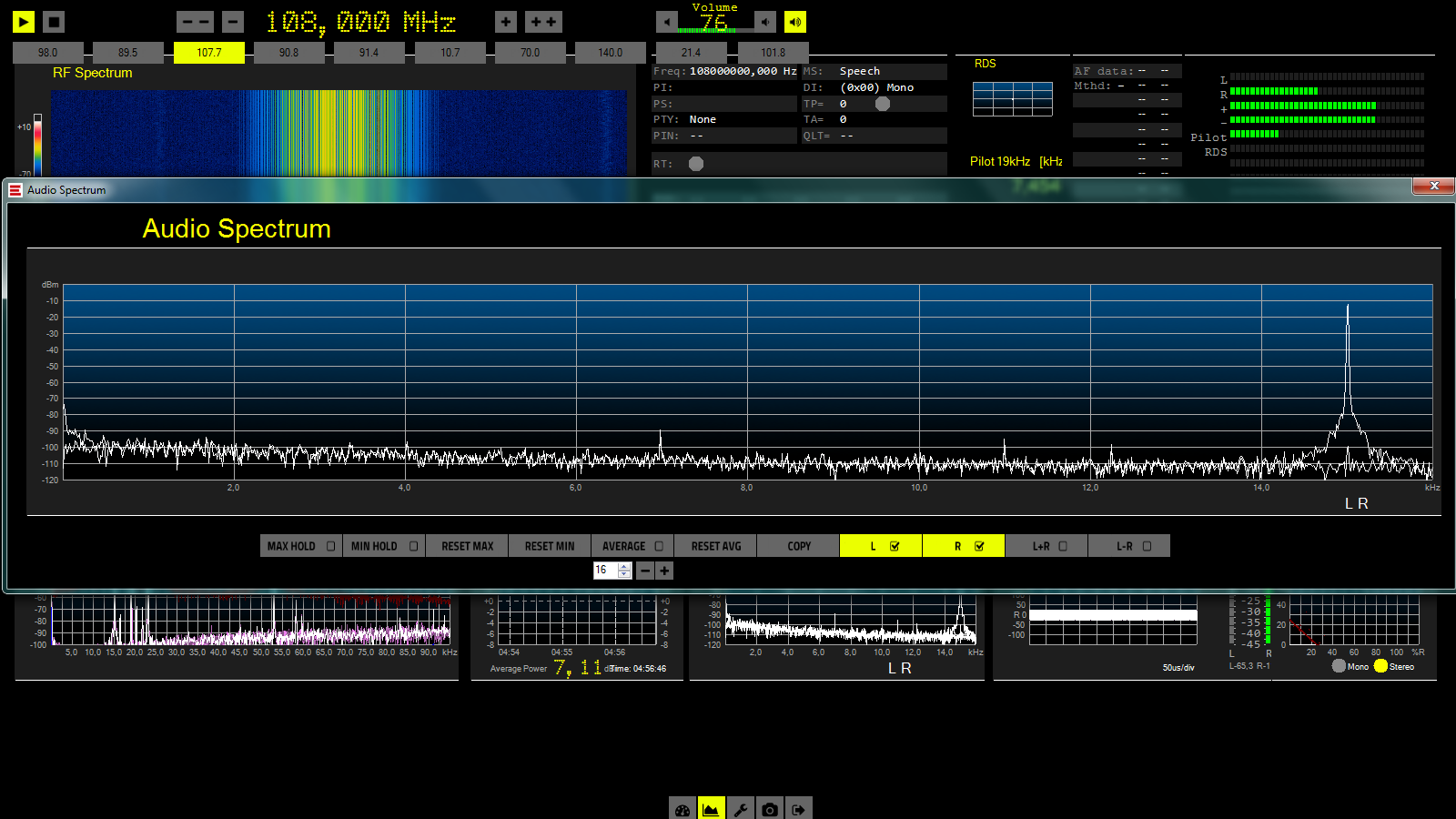
The crosstalk between the L & R channels are the difference of the audio carriers between the two white traces  at 30 - 1000 - 5000 - 15000 Hz .